News

News

Location: Home News Advantages and Disadvantages of Gate Valves

Advantages and Disadvantages of Gate Valves

Views:0

Author: Site Editor

Update time:2026.06.23

Origin: Site

1. Core Advantages of Gate Valves
Low fluid resistance, strong flow capacity
The opening and closing component (gate) of the gate valve moves vertically along the valve seat passage. When opened, the gate aligns with the flow direction, creating a straight-through channel. This design ensures minimal directional change for fluid flow, resulting in extremely low pressure loss (typically ≤0.1MPa), making it particularly suitable for large-diameter and long-distance transportation scenarios (e.g., pipelines with DN300 and above). For instance, in the main water supply pipelines of water treatment plants, gate valves can significantly reduce energy consumption, cutting pumping costs by approximately 30% compared to globe valves.

The sealing performance is reliable and suitable for high-pressure scenarios
The sealing surface of the gate valve is achieved through metal hard sealing or rubber soft sealing, ensuring stable sealing under high-pressure conditions (e.g., PN16-PN40). Taking the ductile iron gate valve as an example, its sealing surface can achieve a roughness of Ra0.8μm after precision grinding. Combined with a hard alloy coating, it can withstand particle wear in the medium and has a service life exceeding 10 years. Additionally, the bidirectional sealing design enables effective flow control under both forward and reverse pressure, making it suitable for applications requiring frequent flow direction switching (e.g., fire protection systems).

Simple structure, low maintenance cost

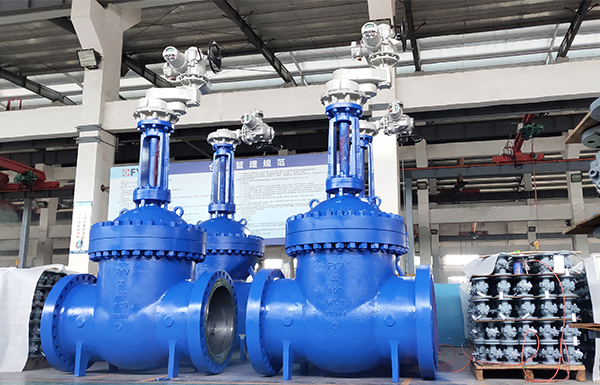
Gate valves have fewer components (typically including only the valve body, gate, stem, seals, and drive mechanism) and lack complex flow channel structures, resulting in lower failure rates compared to globe or ball valves of the same specification. Taking the DN100 manual gate valve as an example, its maintenance cycle can reach 5 years, requiring only periodic inspection of seal wear and lubricant replacement, with a single maintenance cost of approximately 200-500 yuan, significantly lower than the cost of replacing a ball valve's sealing ring (around 800-1500 yuan).

3、 Application scenarios and selection suggestions
Recommended usage scenarios

Large caliber, long-distance transmission pipelines (such as urban water supply and oil and gas long-distance pipelines);
In situations where bidirectional sealing is required (such as fire protection systems, circulating water pipelines);
Systems where the medium is a clean liquid or gas and is sensitive to pressure loss, such as thermal pipelines.
Scenarios that require careful use

In situations where rapid opening and closing is required (such as chemical emergency shut-off valves);
Pipeline systems with limited spatial height (such as underground pipe galleries and ship pipelines);
Media containing a large amount of particles or fibers (such as wastewater, paper pulp).